When investors compare Dubai Property ROI vs US Real Estate, the conversation usually starts with one simple question: where does my money work harder? If you’ve spent any time scrolling through investment forums or talking to people who’ve recently bought property abroad, you’ve probably noticed Dubai coming up a lot more than it used to. It’s not hype for the sake of hype either — the numbers behind Dubai’s real estate market have genuinely shifted the conversation for investors who used to default straight to US property without a second thought.
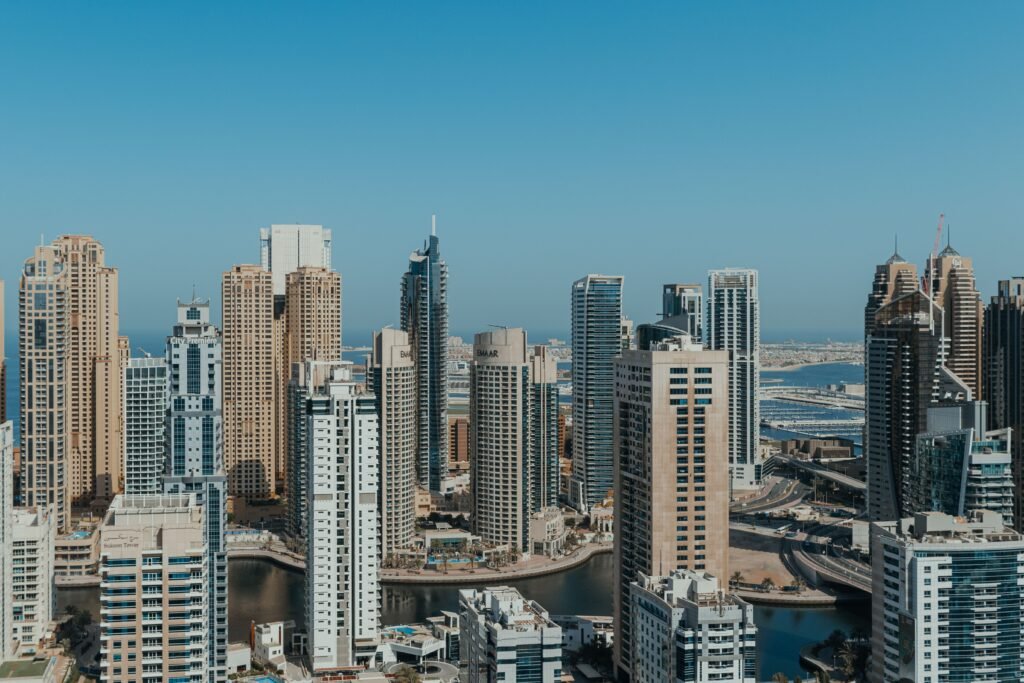
I get asked some version of this question constantly: “Should I put my money into a condo in Miami, or look at something in Dubai Marina instead?” The honest answer is that it depends on what you’re optimizing for. But if we’re talking purely about Dubai Property ROI vs US Real Estate on return alone, the comparison is more interesting — and more lopsided — than most people expect.
Let’s break this down properly, without the sales pitch, and look at what the actual numbers, taxes, and market mechanics tell us.
Investors can review the latest property registration process and ownership-transfer requirements through the official Dubai Land Department website.
Why the Dubai Property ROI vs US Real Estate Debate Matters Right Now
Real estate has always been one of those asset classes where geography changes everything. A rental property in Austin behaves nothing like one in Detroit, and a villa in Palm Jumeirah behaves nothing like an apartment in Deira. So when people ask “is Dubai better than the US for property investment,” the question itself is a bit of a trap — it depends on the city, the property type, and your goals.
That said, there are structural differences between the two markets that hold true regardless of which specific neighborhood you’re comparing. Things like tax treatment, financing costs, rental yields, and government policy create a baseline that’s worth understanding before you even start looking at listings.
Over the last few years, global capital has been moving toward Dubai for reasons that go beyond marketing. The city has built infrastructure, opened up freehold ownership to foreigners, and positioned itself as a tax-friendly hub at the exact moment the US has been raising rates, tightening lending standards, and increasing property tax burdens in many states. That timing is not a coincidence — it’s part of why this comparison has become so relevant.
Dubai Rental Yield Comparison: The Number That Actually Moves the Needle
When investors talk about ROI in real estate, rental yield is usually the first thing they look at, because it tells you how hard your money is working on a year-to-year basis, independent of long-term appreciation. This is also where the Dubai rental yield comparison really starts to favor one side.
In most major US cities, gross rental yields tend to fall somewhere between 3% and 6%. Cities like San Francisco or New York, despite their prestige, often sit at the lower end of that range because property prices have outpaced what rents can realistically support. Even in more landlord-friendly markets like parts of Texas or Florida, yields rarely break past 6% to 7% unless you’re buying in less desirable areas or taking on more risk.
Dubai tells a different story. Average gross rental yields across the city commonly range from 6% to 8%, and certain communities — particularly in more affordable or high-demand rental zones — have posted yields north of 8% or even 9%. That’s not a fluke year either; it’s been a fairly consistent pattern as Dubai’s population has grown faster than its housing supply in certain segments, particularly in the mid-market rental space.
The reason this gap exists comes down to a mix of factors: lower property taxes, a large expatriate population that rents rather than buys, strong demand from international tenants, and developers pricing units in a way that still leaves room for healthy rental margins. It’s not magic — it’s a market that’s structurally set up to favor landlords more than most US cities currently do, and it’s a big reason the Dubai rental yield comparison keeps coming up in investor circles.
US Property Tax vs Dubai Property Tax: The Silent ROI Killer
This is where the Dubai Property ROI vs US Real Estate comparison really starts to separate. In the United States, property ownership comes with a layered tax structure that quietly eats into returns over time, even when the headline numbers look attractive.
When you weigh US property tax vs Dubai property tax, the difference is stark. Property taxes in the US vary wildly by state, but they typically range from 0.5% to over 2% of the property’s assessed value annually. In states like New Jersey, Illinois, or Texas, that tax burden alone can offset a meaningful chunk of your rental income before you even factor in maintenance or vacancy costs.
On top of that, rental income is subject to federal income tax, and depending on your state, possibly state income tax as well. If you eventually sell, capital gains tax comes into play too, and for non-resident foreign investors, there’s the added layer of FIRPTA withholding, which can tie up a portion of your sale proceeds during the transaction process.
Dubai, by contrast, has built its reputation as a real estate market partly around the absence of these frictions. There’s no annual property tax. There’s no personal income tax, which means rental income isn’t taxed at the individual level. There’s no capital gains tax on property sales for individual investors. The main costs investors deal with are a one-time Dubai Land Department transfer fee (typically 4% of the purchase price) and standard service charges for building maintenance, which vary by development.
When you run the US property tax vs Dubai property tax numbers side by side, a property in Dubai generating an 8% gross yield can often outperform a US property generating a nominal 6% yield on a net, after-tax basis, simply because so much less is being clawed back by various tax authorities. This is one of the most underappreciated parts of the ROI conversation — people compare gross numbers without realizing how much of the US figure gets eroded before it ever reaches their pocket.
Entry Costs and Financing: A Different Kind of Math
Buying property in the US, especially as a foreign national, often involves a more complex and sometimes more expensive entry process than people expect. Mortgage rates for non-resident buyers tend to run higher than standard rates, down payment requirements are often steeper (sometimes 30% to 40% for foreign buyers), and the overall closing process involves more legal and administrative cost.
Dubai has gone in the opposite direction over the past decade, actively trying to make the entry process smoother for international buyers. Many developers offer attractive post-handover payment plans, sometimes spreading payments over several years even after the buyer takes possession of the unit. This is a structural difference that changes the entire cash flow profile of an investment — instead of needing the full purchase price (or a large mortgage) upfront, investors can often start generating rental income while still completing payments on the property itself.
This doesn’t mean Dubai financing is risk-free or that payment plans are always a good idea. They need to be evaluated carefully, developer by developer, because not every project delivers on time or as promised. But from a pure capital efficiency standpoint, it’s a meaningfully different starting point than the traditional US mortgage process.
Appreciation: Where Dubai Real Estate Investment Returns Get More Nuanced
This is the part of the conversation where I’d push back a little on anyone telling you Dubai is simply “better” across the board. Long-term capital appreciation in the US, particularly in established, supply-constrained markets, has a track record that spans decades. Cities with strong job growth, limited land availability, and consistent population inflows — think parts of the Sun Belt, or historically, coastal markets before they became prohibitively expensive — have shown durable, if sometimes slow, appreciation over long time horizons.
Dubai real estate investment returns on the appreciation side tell a younger, more volatile story by comparison. The market went through a well-documented boom-and-bust cycle in the late 2000s, and even in more recent years, certain segments have seen sharper swings than a typical US market would experience. The current upswing has been strong, driven by population growth, foreign investment inflows, and policy changes like the long-term residency visas tied to property investment, but it’s fair to say Dubai’s appreciation curve has more volatility baked into it than a mature US market.
What this means practically is that if your priority is long-term, slow-and-steady capital growth with a long track record behind it, US real estate in the right markets still has an argument to make. If your priority is current cash flow and yield, paired with a market that’s actively engineering itself to attract foreign capital, Dubai real estate investment returns currently have the stronger numbers on the income side.
Currency and Geopolitical Considerations
One thing that doesn’t get discussed enough is currency stability. The UAE dirham has been pegged to the US dollar for decades, which removes a layer of currency risk that investors in many other international markets have to account for. This is actually a point in Dubai’s favor for US-based or dollar-denominated investors — you’re not taking on additional currency exposure the way you would investing in, say, a market with a floating or historically volatile currency.
From a geopolitical standpoint, the UAE has positioned itself as a stable, business-friendly jurisdiction, which has helped attract capital that might otherwise be nervous about emerging markets. The US, despite its own political noise, remains the benchmark for institutional stability and rule of law, which is part of why so much global capital still defaults there regardless of yield comparisons. Stability and yield aren’t always the same conversation, and it’s worth being honest about that rather than pretending one market wins on every dimension.
Liquidity and Exit Strategy
Selling a property in the US, particularly in major metro areas, tends to follow a fairly predictable process with established legal frameworks, title insurance norms, and a deep pool of both domestic and international buyers. Liquidity in top-tier US markets is generally strong, especially for well-located residential property.
Dubai’s resale market has matured significantly but is still smaller in absolute terms than the major US metros. That said, the buyer pool is increasingly international, with strong demand from Europe, Asia, Russia, and other Gulf countries, which has helped liquidity improve year over year. The Dubai Land Department has also made the registration and transfer process relatively efficient compared to many other international markets, which helps offset some of the liquidity gap.
For investors thinking about exit timelines, it’s worth noting that off-plan properties in Dubai (units purchased before or during construction) carry different liquidity characteristics than completed, ready properties. Ready properties with title deeds in hand tend to be easier to resell quickly than off-plan units still mid-construction.
Putting the Numbers Together: A Realistic Example
Let’s say you’re comparing a $300,000 property investment in each market, just to make the Dubai Property ROI vs US Real Estate comparison concrete.
In a mid-tier US market, that $300,000 might get you a property generating around 5% gross rental yield, or $15,000 a year in rental income. After property taxes (let’s estimate 1.2%, or $3,600), insurance, maintenance, and income tax on the remaining rental profit, your net return often lands somewhere in the 2.5% to 3.5% range, depending on your tax bracket and state.
The same $300,000 in a solid Dubai community might get you a property generating closer to 7% to 8% gross yield, or $21,000 to $24,000 a year. With no property tax, no income tax on rental earnings, and only service charges (typically a few thousand dirhams annually depending on the building) eating into that figure, your net yield often lands much closer to the gross figure — frequently in the 5.5% to 7% range after costs.
That gap, compounded over a five- or ten-year holding period, is significant. It’s the kind of difference that shows up clearly in a portfolio’s overall performance, even before you factor in any appreciation on either side.
Best Real Estate Investment Dubai or USA: What This Means for Different Investors
If you’re trying to figure out the best real estate investment Dubai or USA for your own situation, it really comes down to what you’re optimizing for. If you’re an investor primarily focused on cash flow — someone who wants the property to pay for itself and generate meaningful income along the way — Dubai’s combination of higher yields and zero income tax makes a strong case right now. This is especially true for international investors who don’t have an existing tax obligation tied to UAE property income.
If you’re an investor who values long-term institutional stability, a deep and liquid resale market, and a multi-decade track record of appreciation in specific high-demand US metros, the US market still has a legitimate place in a diversified portfolio. Nobody serious about wealth building should treat the best real estate investment Dubai or USA question as an either-or decision — the smarter approach for most people is understanding what each market does well and building exposure accordingly.
It’s also worth saying clearly: neither market is risk-free. Dubai’s off-plan segment carries developer risk that doesn’t really have an equivalent in most US transactions. The US carries higher transaction friction, tax drag, and in some states, landlord-unfriendly regulations that can complicate rental income strategies. Doing this comparison honestly means acknowledging the downsides on both sides, not just cherry-picking the numbers that support whichever market you already prefer.
Final Thoughts on Dubai Property ROI vs US Real Estate
The Dubai Property ROI vs US Real Estate debate isn’t really about one market being objectively superior — it’s about understanding what each one is currently optimized for. Dubai has built a tax structure, regulatory environment, and rental market that currently favors yield-focused investors more clearly than most US markets do. The US still offers a depth, stability, and long-term track record that’s hard to replicate anywhere else in the world.
If your goal is maximizing current income and minimizing tax drag, the Dubai numbers right now are genuinely compelling, and it’s not surprising that international capital has been flowing in that direction. If your goal is long-term wealth preservation in one of the most legally stable property markets in the world, the US still earns its place in the conversation.
The right move for most serious investors isn’t picking a side in the Dubai Property ROI vs US Real Estate debate — it’s understanding both markets well enough to know where each one fits in a broader strategy, and making that decision with real numbers in front of you rather than headlines.
If you want to dig into specific projects, yield comparisons, or a tailored breakdown based on your own investment goals, that’s a conversation worth having directly rather than trying to generalize it for every reader.
California-based investors can also read our complete guide on how to buy property in Dubai from California before comparing individual investment opportunities.